I’ve started calling it the In-Between Time
A map of the space between chapters. Part one of a few.

I've started calling it the In-Between Time
A company sells. A role ends. A long bet pays off, or finally doesn't. The space that follows is the part nobody talks about. We don't even have good terminology for it
I ran a workshop on it last week at Summit at Sea. What surprised me wasn't what people were going through. It was how alone everyone felt going through it. We often treat our in-between as a problem to escape from. Rush to the next thing. Numb out. Pretend we already know what's coming. I think that is often a wrong move. The in-between isn't a void to fill. It's where the next chapter actually gets shaped and probably the most entrepreneurial we will ever be.
Anthropologists call this liminality. The threshold phase between two states, where the old structures dissolve before the new ones form. It's the tumble dryer. The scrambling is what makes it possible to be reformed into something else. Part of what makes it so hard is that you don't know how long it lasts. Most thresholds come with a clock. Puberty has a window.
A sabbatical has a return date. The in-between time has none of that. You're inside it without knowing whether you're in week two or month eighteen, and that uncertainty is most of the difficulty.
The hardest part isn't logistical, it's narrative. The fear of losing relevance. The pressure to have an answer to "What are you doing next?"
The quiet voice that says everyone else is further along. Since you can't time-box it, the most useful move is to locate yourself inside it. Here's the rough map I've been working with (thanks, Alex Kuilman, for the help).
Eight phases. You don't move through them on a schedule, and you can slip backward as easily as you can move forward.
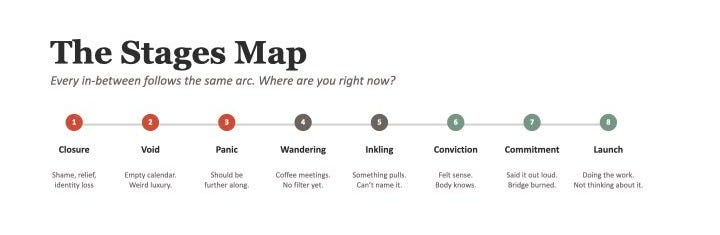
The eight phases
1. Closure. Shame, relief, identity loss, often at once. The work is letting it actually be over. Not narrating it yet. Not turning it into a lesson. The first temptation is to write the LinkedIn post about what you learned. Resist for a few weeks. The lesson you tell yourself in week one is rarely the right one.
2. Void. Empty calendar. Feels like vacation for three days, then something else entirely. The work is resisting the urge to fill it. Most people I see in this phase book themselves back-to-back within ten days. The meetings feel productive and accomplish nothing. Try keeping two days a week genuinely empty.
3. Panic. “I should be further along.” The reflex is to grab the first plausible next thing. Panic is information about your fear, not your situation. One exercise that helps: write down what you’d do if you had two more years before you needed to decide. Most of the panic-grabs disappear on the page.
4. Wandering. Coffee meetings, no filter yet. You float ideas you don’t believe in just to hear how they sound out loud. Looks unproductive. Is essential. You're building the narrative that will become your next source code. The mistake is judging yourself for the inefficiency. The job of Wandering is to generate enough surface area for an Inkling to land on. Track the ideas you keep coming back to without trying to.
5. Inkling. Something pulls, and you can’t name it. A theme keeps showing up. The work pays attention to the pull rather than dismissing it. Most Inklings get killed by the first reasonable person you describe them to. Be idea promiscuous. Just pick - just try to do them all a little bit and see what feels right.
6. Conviction. Felt sense. The body knows. You can’t argue for it on a spreadsheet, but you know. People around you usually notice the change before you announce anything. Conviction without commitment is dangerous. It evaporates in a bad week. Move fast to the next phase.
7. Commitment. Said it out loud. Bridge burned. There is now a real cost to backing out. Tell people who will hold you to it. Momentum is oxygen. I, more than most, believe that you can even do more than one thing at the same time.
8. Launch. Doing the work. Not thinking about it. The In-Between is over. You’re inside the next chapter. The signal: you’ve stopped having “what am I doing with my life” conversations with friends. You’re having “here’s the thing I’m working on” conversations.
What helps where
What helps in Panic doesn’t help in Inkling. What helps in Wandering can quietly kill Conviction. The exercises that work in each phase are different, sometimes opposite. Naming the phase is the first move.
I’m going to write more about the In-Between Time. Subscribe if you want them as I publish.
If you’re in one of these phases right now, or know someone who is, hit reply and tell me if you have any tips. I’m building more exercises around the messages I get back.
Onwards and upwards.