
Refounding
A framework for rebuilding your company as if you were starting it today.

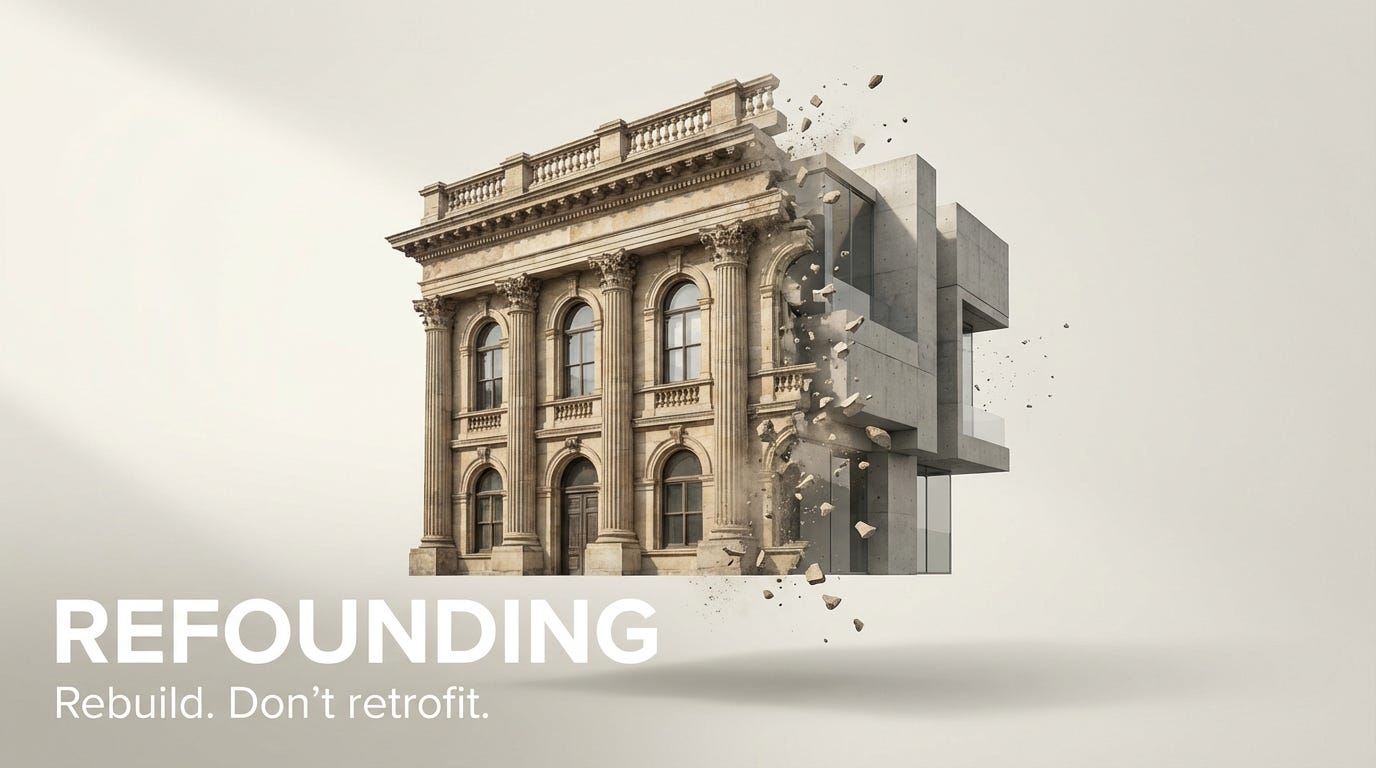
Most companies are approaching AI as an optimization layer. They are reducing costs, automating workflows, and incrementally improving what they already do. This is understandable.
But I believe it is insufficient.
AI is not a feature to be bolted on. It is a foundational shift that changes how products are built, how companies are structured, how customers engage, and how value is created. The companies that understand this will not optimize their way into the future. They will rebuild for it. The point is not to retrofit. It is to replatform. [1]
The risk worth naming here is not just that companies move too slowly. It is that they move with purpose in the wrong direction. Consider Chegg. For years, the company dominated the homework-help market. When AI arrived, leadership did not ignore it - the CEO met personally with Sam Altman, and the company moved aggressively. By late 2025, Chegg had cut 56% of its global workforce. Not because it failed to implement AI. Because it never asked whether what it was building still mattered. They asked, “How do we use AI to improve what we do?” They should have asked: given what AI now makes possible, does what we do still need to exist? Those are not the same question. The real risk of this moment is not a failed implementation. It is a successful one - two years of optimizing a platform your market is quietly moving away from. [12]
I call this refounding: taking an existing company and rebuilding it as if you were creating it today, in a world where AI is native infrastructure, not an add-on.
This paper outlines how I think about it. The framework comes from fifteen years of building ventures inside large organizations and from the early stages of applying this approach to several companies I am involved with now. It is a work in progress, not a finished playbook. But the patterns are becoming clear enough to share. The framework is structured around five vectors and a four-phase process.
The Five Vectors. Refounding requires rethinking a company across five dimensions. Each addresses a different layer of the business. Together, they provide a blueprint for transformation.
1. Team. Most organizations overestimate their AI capability. In my experience, there is a gap - often a chasm - between people who say they use AI and people who actually build with it.
I find it useful to think about four levels of AI maturity. At level one, people use AI as another way of Googling. At level two, they have actual conversations with AI. At level three, they add context - connecting AI to their workflows, threading in external tools, giving it memory with access to email, databases, or MCPs. At level four, they create agents that go out and do autonomous work on their behalf. [2]
Most people in existing organizations sit at levels 1 and 2. AI-first companies operate at level four. The distance between them is not just a training problem. It is a talent and mindset problem.
The skills that matter here are the same entrepreneurial qualities I have always screened for: agitation (how much do they push things forward?), resourcefulness (how much can they do with little?), and gravity (can they craft the story that pulls people and agents into orbit?). [3] In an AI-native world, these traits compound. Curious, untethered people can now operate at a scale that was previously impossible.
In practice, this looks like a new kind of role I think of as the forward-deployed entrepreneurial AI manager. These are not traditional engineers, nor traditional entrepreneurs. They are people who sit close to the front lines of the business, identify problems as they encounter them, and build AI-native solutions on the spot. They ask: what if I could solve this right now? And then they do. I believe this is the archetype refounding teams should be built around. [4]
In most cases, this means building a new team from scratch, not upgrading the existing one. The objective is a future-native organization, unburdened by legacy habits and built for the world as it is today.
2. Product. AI impacts products differently depending on what they are. The critical strategic question is whether AI is improving the existing product process or replacing it entirely.
Consider a subscription pet products company, an apparel brand, and a regional logistics operator. In all three cases, the core output stays the same: physical goods, moving through physical supply chains. AI improves how those products are designed, sourced, selected, and delivered - but the thing itself remains tangible. Call this AI-enhanced.
Now consider a wedding planning marketplace. Here, the product could be fundamentally replaced by an AI-native experience - one where conversational agents orchestrate the entire planning process rather than a static website. This is a different category entirely. The product itself becomes AI. [5]
Between these poles is a middle ground: products that stay recognizable but whose experience changes meaningfully. Refounding requires explicitly choosing which path you are on. The answer determines the scope of everything that follows.
3. Customer Experience. The conventional framing of AI in customer experience centers on personalization. I think this is too narrow.
The real shift is from personalization to relationship.
AI enables something fundamentally new: continuous, intimate dialogue with customers at scale. Not recommendations. Relationships. A company gains persistent memory of preferences and behavior, real-time adaptation to needs, and the ability to be genuinely present in the customer’s life. We call this relationship capital at scale. [6]
I have written about relationship capital before - most directly in Me, My Customer & AI - and the core idea has not changed: the advantage a company accumulates through genuine customer relationships compounds over time and is very difficult for competitors to replicate. What AI changes is the scale at which this becomes possible. The three dimensions still hold. Depth: does the company truly understand each customer, well enough to anticipate what they need before they ask? Density: are there enough meaningful touchpoints that the relationship feels continuous rather than transactional? Durability: does the customer grant you permission to grow with them - to offer new products and services beyond what first brought them in? AI transforms all three simultaneously. Depth improves because the conversation never resets. Density increases because every interaction can carry meaning. And durability matters more than ever, because in an AI-native world, the half-life of any given product or service is shrinking. The companies that survive will be those whose customer relationships outlast their current offerings. The brand becomes the constant. The products rotate.
For a product like dog toys or garments, the output itself may not be radically personalized - at least not initially. But the selection of which product reaches which customer can be. And the conversation that surrounds it - understanding needs, anticipating wants, building trust over time - that becomes the real differentiator.
The winning companies will not just serve customers. They will know them continuously - and the customers will feel it.
4. Organizational Model. Refounding is hard to do inside the existing organizational structure. Legacy organizations optimize for control, efficiency, and risk reduction. AI-first building requires speed, experimentation, and autonomy.
But there is a deeper problem that I keep seeing. Even when organizations adopt AI tools, they rarely capture the value. A designer who can now write copy and create marketing assets with AI has freed up significant capacity. But the marketing team still exists. Neither headcount is reduced, and the freed time becomes invented work - more meetings, more process, more internal alignment - rather than strategic redeployment. Internally, we call this the organizational design gap: AI creates capacity that existing structures cannot absorb. [7]
The solution is structural. Build a small, independent team with direct access to the CEO or owner. In military terms: not another department reporting through the org chart, but a SEAL team reporting directly to the president. [8]
This team operates with full autonomy, separate incentives, and protection from legacy processes. It is not a task force. It is an independent unit with a mandate to build.
Interaction with the core organization should be API-like, not political. Use internal capabilities only when they are genuinely best-in-class. Otherwise, go external. Organizations instinctively believe their internal teams should be used - legal, engineering, operations. In practice, external services are often faster, cheaper, and better suited to the pace required. The refounding team should default to external-first, internal-when-necessary. [9]
Without this discipline, the team gets absorbed into legacy processes, organizational politics, and the glacial pace of institutional decision-making. The API metaphor provides a clean mental model: if the internal service has a good interface and fast response time, use it. If not, route around it.
5. Financial Model. Most companies start the AI conversation with cost savings, and for good reason. Many organizations carry years of organizational debt: bloated teams, redundant processes, accumulated inefficiencies. AI offers a path to paying down that debt significantly.
But efficiency is only half the story. Process improvement drives bottom-line growth, not top-line. A 30% EBITDA improvement through AI-driven efficiency is quickly becoming table stakes. The companies that stop there will find themselves leaner but not more competitive. They will have optimized their way to a smaller version of the same business.
What I think matters more is the top-line question. AI does not just cut costs. It enables a fundamentally different engine for experimentation. Companies can test new products, new services, and new business models at a fraction of the cost and time it used to take. I believe that the real value lies in the combination of a leaner cost base and this new capacity for rapid experimentation.
So the task of refounding is not to optimize the current business. It is to redefine what business you are in. This means revisiting fundamental questions. Who is the customer now? What is the core value proposition? How do we scale in an AI-native world? Companies that refound well will operate with both a leaner cost structure and a more expansive strategic vision than they had before.
The Process. This framework is adapted from incubation programs we have run over fifteen years inside large organizations - programs structured around three core phases of building, with a fourth decision phase. We are now beginning to apply this same structure to AI refounding, and while it is early, the fit feels right. [10]
Phase 1: Design (4–6 weeks). The work begins with a structured workshops with senior leadership, working through each of the five vectors to assess the current state and define the target. The output is a refounding blueprint: a detailed report covering the AI-first opportunity, the recommended approach across all five dimensions, and a prioritized roadmap for what comes next.
A critical part of this phase is establishing what we call the foundational narrative. AI systems are only as effective as the clarity of the organization’s purpose. If a company cannot answer four questions - who do you serve, what problems do you solve, what gives you authenticity, and what gives you authority - then no amount of AI tooling will compensate. Narrative is the new source code. It determines what AI builds, how it communicates, and who it serves. Phase 1 must produce this clarity before anything else moves forward. [11]
Phase 2: Prototype (6–12 weeks). A small AI-first team is activated and focused on one high-leverage area identified in Phase 1. The goal is to build something real - a working prototype or service - that validates feasibility and demonstrates what AI-native speed and capability look like in practice. This is the phase that shifts the conversation from strategy to evidence.
Phase 3: Deploy (3–6 months). The team expands. The prototype integrates into actual operations. Customer-facing rollout begins. The focus is on execution speed, learning loops, and measurable impact. This is where the refounded operation starts to prove itself against the existing business - and where the organization begins to see what AI-first actually means in practice.
Phase 4: Decide. At this stage, one of three paths emerges. The AI-first operation integrates into the core business. It spins out as an independent entity. Or it shuts down and the learnings are redeployed elsewhere. Each outcome is valid. The framework is designed to generate clarity quickly enough that this decision is informed by real data, not speculation.
AI is not just a technology wave. It is a company design event.
The companies that win will not be those that add AI features, run pilots, or optimize workflows. They will be the ones who rebuild themselves from first principles, with AI as foundational infrastructure rather than an afterthought.
Refounding is difficult. It challenges existing teams, bypasses existing structures, and redefines existing strategies. It requires leadership conviction, structural autonomy, and the willingness to build something genuinely new inside or alongside what already exists.
But it is also faster than incremental change, cleaner than transformation programs, and far more aligned with where the world is heading.
The companies that look back on this period as a defining win will not be those that moved fastest on headcount or launched the most pilots. They will be the ones who have had the courage to ask the harder question early - and to build the answer rather than waiting for it. Most organizations I encounter have an AI roadmap. Almost none have a refounding plan. This paper attempts to sketch what one looks like.
- HW
Endnotes
[1] The distinction between retrofitting and replatforming matters because it determines scope. Retrofitting works within the existing organizational logic - same team, same structure, same assumptions, just faster or cheaper. Replatforming questions those assumptions entirely. It asks: if we were starting this company today, knowing what we know about AI, what would we build? How would we staff it? How would we talk to customers? The answer is almost never “what we have now, but with a chatbot.” The electricity analogy is instructive: the first-order impact of electricity was not replacing gas lamps with light bulbs. It was production lines, mass production, consumer appliances, and entirely new business categories. We are at a similar inflection point.
[2] These four levels of AI maturity are not purely technical. They reflect a mindset. Level one and two users treat AI as a tool they consult. Level three and four users treat AI as a collaborator or employee. The difference in output between these groups is already an order of magnitude, and growing. Companies that staff their refounding teams with level one and two users will produce level one and two results.
[3] These three traits - agitation, resourcefulness, and gravity - come from years of working with founders in venture development. They are not the only traits that matter, but in my experience they are reliable predictors of whether someone will thrive in an early-stage, ambiguous, build-from-scratch environment. AI amplifies all three: an agitated person with access to AI agents can push further, faster. A resourceful person can do the work of a team. A person with gravity can use AI to tell better stories and align more stakeholders.
[4] The forward-deployed entrepreneurial AI engineer is a distinct archetype. Traditional engineers optimize systems. Traditional entrepreneurs identify opportunities. This role does both simultaneously - sitting at the intersection of domain expertise, AI fluency, and entrepreneurial instinct. One useful screening question for organizations: who among your people would leave to start their own company in the next 24 months? Those are likely your forward-deployed engineers. They have the restlessness, the curiosity, and the bias toward action that refounding demands.
[5] The distinction between AI-enhanced, AI-augmented, and AI-native products is critical because it determines how much of the existing organization’s capabilities remain relevant. An AI-enhanced company keeps most of its value chain intact. An AI-native company may need to rebuild everything. Misdiagnosing which category you’re in leads either to over-investment (rebuilding things that didn’t need it) or under-investment (polishing a product that’s about to be made obsolete).
[6] The concept of relationship capital is developed more fully in Me, My Customer & AI. The core argument: the advantage a company accumulates through genuine customer relationships compounds over time in ways that technology alone cannot replicate. Relationship capital has three dimensions. Depth measures how well a company truly understands each customer - can you anticipate their needs, speak their language, make an introduction between two of your customers and have them find something in common? Density measures the number of meaningful touchpoints - does every interaction add something, or is most of the relationship transactional and forgettable? Durability measures whether the relationship outlasts any single product - does the customer give you permission to grow with them, or do they leave the moment something better comes along? AI does not change this framework. It supercharges it. What was previously impossible - a genuinely personal, continuous conversation with millions of customers at once - is now feasible. The companies that figure this out first will build moats that look less like technology and more like trust.
[7] The organizational design gap is, in my view, one of the least-discussed yet most consequential barriers to AI transformation. I keep seeing the same pattern: a designer with AI tools can now produce work that previously required a designer, a copywriter, and a production artist. But the copywriter and production artist still have jobs, still attend meetings, and still need to justify their roles. The freed capacity does not flow into strategic work. It flows into organizational theater - more decks, more alignment sessions, more check-ins. Until companies redesign their structures to match AI’s capabilities, they will keep paying for capacity they are not using. This is the hidden cost of optimization without refounding.
[8] The SEAL team analogy is intentional. These units are small, highly skilled, and given missions with clear objectives and significant autonomy over how to achieve them. They report to the highest level of command, not through the bureaucratic chain. Most importantly, they are selected for a different kind of work than the regular army. The same logic applies here: you need a different kind of person, with different incentives, different tools, and a different reporting structure.
[9] This is where many refounding efforts die. The parent organization, often with the best of intentions, offers to “help” by providing its internal services. Use our legal team. Use our engineering resources. Use our procurement process. In practice, these internal services are optimized for the parent’s pace and risk tolerance, not for a startup’s. The refounding team ends up waiting weeks for approvals that could be resolved in hours externally. The API metaphor is useful precisely because it forces a question: is this internal service actually faster and better than the alternative? If yes, use it. If not, don’t.
[10] This four-phase model is adapted from incubation programs we ran over 15 years, in which the same structure was used to build new ventures within large organizations. The insight that carries over: the single greatest risk in corporate innovation is not failure to build. It is a failure to decide. The fourth phase - integrate, spin out, or shut down - is as important as the first three combined. Without a forcing function for this decision, efforts linger in organizational limbo indefinitely.
[11] Narrative as source code is not a metaphor. In an AI-driven organization, the clarity of the company’s purpose literally determines the quality of what AI produces. A vague mission statement yields vague outputs. A precise, honest articulation of who you serve and why yields AI that can communicate, build, and decide on behalf of the organization with genuine coherence. This is also why gravity - the ability to craft a compelling story - is such a critical trait for refounding teams. Recent academic research studying over 500 entrepreneurs found that execution speed predicted revenue more reliably than idea quality. Narrative clarity is what makes execution speed possible. When everyone - humans and agents alike - knows what the company is for, decisions happen faster and with less friction.
[12] The framing of “optimizing the wrong company” draws on Amalia Goodwin, “The Real AI Risk Isn’t Falling Behind. It’s Optimizing the Wrong Company,” Medium, March 2026.
I am genuinely surprised this article hasn’t got more reach. It’s a great representation of the current sutiation